Friday, August 30, 2013

Greeley must protect quality of life for residents

By Therese Gilbert

I seldom see the Rockies clearly from Greeley anymore. My sisters, during their visit two weeks ago, noticed this as well. Having grown up in Colorado and now living out of state, they look forward to seeing that beautiful and familiar vista to the west. What accounts for this gray-brown haze on blue-sky days? We can’t possibly match the traffic level of metro Denver, so what could be contributing to this poor air quality?

Within the last 10 years, there has been an accelerated rate of oil and gas development in Weld County. While the industry has brought in some revenue and created jobs, the cumulative effect of this drilling on our air quality is now becoming apparent. We currently have over 20,000 active wells in Weld County, and new additional drilling projects, already permitted by the state, will soon close the “donut hole” within city limits.


Drilling within the center of Greeley has been last for obvious reasons; the risks of such development are simply not compatible with the quality of life that most residents consider acceptable. Since March of this year, over 181 wells were permitted to drill, many within 500 feet of schools.

Behind Frontier Academy and Walmart 67 wells are planned.
The red dot is where the drill rig will be placed; the dots and
yellow stripes at the bottom are storage tanks and separators.


 The process of hydraulic fracturing involves adding over 600 chemicals to 2-10 million gallons of clean water and sand per well, and the mixture is injected with great force to open up rock fissures underground that allow natural gas to escape and be captured on the surface. The gas is collected in the large, cylindrical, beige colored tanks that blotch our landscape.


If unsightliness were the worst feature of these tanks, we might have reason to complain, but little to worry us. However, what we don’t see is the problem. Toxic gases such as benzene, ethylbenzene, xylene, ethane, toluene, and others leak from these condensate tanks, some of which cause cancer and respiratory illnesses. The highest industry standard allows for 2% of the gases to escape, but it is estimated that many leak more than 5%.


Now, imagine the cumulative effect of over 20,000 wells leaking 5% of their toxic gases! Most emissions escape during the initial drilling process, and according to one study, those living within half a mile of natural gas wells are at the highest risk for exposure. (2012 Colorado School of Public Health, University of Colorado – McKenzie, Witter, Newman, Adgate)

 A recent study has found that oil & gas production in Weld County contributes 55% of the VOC’s (volatile organic compounds) that cause ozone pollution in the northern Colorado region, and for the past 2 years the air in Weld County has been out of compliance with federal standards for ground level ozone. (2013 Cooperative Institute for Research in Environmental Sciences – Gilman, et al)


As residents of Weld County and Greeley, we are surrounded with the consequences of this heavy industrialization every day. The latest project by Synergy Corporation proposes to add 12 horizontal wells and 25 condensate tanks to a site within 450 feet of the track at Northridge High School where students exercise. Is this responsible development?

Should we be risking the health of those who must live so close to this drilling? We were given this beautiful planet to call our home, and we must be responsible stewards of this gift. A healthy environment is a safe home; let us be careful in making choices that might forever damage the precious air we breathe. I urge our city council to make decisions that not only protect the rights of mineral owners, but protect the quality of life for those of us living and breathing on the surface.

Friday, August 16, 2013

Greeley Ignores Criteria For Proper Planning

In the past seven months the Colorado Oil and Gas Conservation Commission (COGCC) issued permits for 181 oil and gas wells to be drilled and fracked in Greeley, but according to criteria in the city's 2020 Comprehensive Plan  the city council should deny them!

Take a look!

Land Use (LU4.3) Disallow high impact agricultural and heavy industrial land uses that generate obnoxious influences, such as noise, fumes, or hazards. ~ Page 197
From Source Watch Colorado and Fracking: A study conducted over three years by the Colorado School of Public Health concluded that fracking can contribute to “acute and chronic health problems for those living near natural gas drilling sites”... "The study found those living within a half-mile of a natural gas drilling site faced greater health risks than those who live farther away." Researchers located “potentially toxic petroleum hydrocarbons in the air near the wells including benzene, ethylbenzene, toluene and xylene.” See: Health Effects
Environment (EN3.B) Disallow the establishment of any new businesses or industry which will create offensive outdoor odors. ~ Page 114

EN5.10 C) Carefully balance economic benefits from mining activities with the social cost related to the altered environment.~ Page 120

EN3 Air Quality - In order to protect and promote a healthy, pleasant, and economically viable community, the quality of the air must be improved to minimize offensive odors and have a minimum of pollutants. ~ Page 113

 EN3.2 Maintain full compliance with federal air quality standards and reduce stationary and mobile source emissions of pollutants with special emphasis placed upon efforts to reduce pollutants which cause adverse health effects and impair visibility.
From and article in the Denver PostOil and gas emissions now are the main source of volatile organic compounds in Colorado and the third-largest source of nitrogen oxides, at a time when a nine-county area around metro Denver is already failing to meet federal clean-air standards, state data show...State air monitoring has found that oil and gas sources currently emit at least 463 tons a day of smog-forming VOCs and 149 tons a day of nitrogen oxides — much of it in the ozone-prone Front Range corridor. Read more: Oil and gas air pollution
 EN3.5 Incorporate air quality objectives into the land use planning and development process by encouraging land use patterns which reduce travel and air emissions.

A) Evaluate all zoning and land use development requests for their impact on air quality. ~ Page 115

EN5.11 Maintain minimum setback and site design standards from oil and gas wells and tank batteries which protect the public’s interest through attention to safety and compatibility issues relative to adjacent properties.

EN6.7 Work with the Division of Wildlife on development in proximity to natural areas to assure sensitivity in the siting and design of urban features in key wildlife and related habitat areas. ~ Page 121

EN1.4 Consider wildlife movement corridors in the siting and development of urban uses to assure that native species are able to access habitats without human interference. ~ Page 111

EN8 View Shed and Important Corridors - In order to improve the area quality of life, enjoyment of community, and appreciation of natural resources, the City should promote the development of the community in such a way as to protect key view sheds and travel corridors and reflect in the built environment a sensitivity to the areas of environmental significance. ~ Page 123

EN8.1 Develop a list of important corridors and areas which carry environmental significance and/or visual appeal related to its natural features and establish special design treatments along such areas. Evaluate the following areas for inclusion on such a list:

A) Bluff area along northern edge of community;
B) Sheep Draw;
C) Ashcroft Draw;
D) Confluence of the Cache la Poudre & South Platte rivers;
E) “O” Street corridor;
F) Cache la Poudre River corridor; and,
G) U.S. Highway 34 corridor

EN8.3 Protect open lands in strategic areas within and around the community in order to provide visual relief from the urban landscape, preserve important vistas, and/or retain separation from other communities. ~Page 124

A) recognize the value in retaining agricultural crop land in acknowledgment of the community’s heritage and the opportunity for this land use to meet this strategy as long as Right-to-Farm protections are provided.

LU2.19 Residential development should be the primary land use adjacent to elementary, middle and high schools. Discourage zoning or development of property which diminishes residential population in an area which is supported by a neighborhood school, or which poses safety impacts to children.

LU4.2 In new site development residential uses should not be allowed adjacent to medium or high intensity industrial uses and zones to prevent unnecessary conflicts between such uses and to promote the expansion of industrial sites without undue hardship of needing to address mitigation or buffering treatments and impacts to residential and other low-impact uses. ~ Page 197


Thursday, August 15, 2013

French Film Crew in Greeley in Search of Fracking

"Would you want to meet with a french film crew, and help show them around? They want to do a film on fracking in Weld." 

That was the message I found in my inbox yesterday. "Heck, yes! Of course I wanted to show them around! Let's get word and video out to the world beyond our city limits, and borders, of how dreadful the oil & gas installation infestation has become here! When was the last time we had a clear view of the mountains?

Unfortunately I forgot to take along my photo camera, and cannot show that I and two others actually did meet the crew. It was six o'clock when they finally arrived at the Kress theater where we'd been waiting for almost an hour. It turns out they'd been wandering around up north, near Grover!

After introductions I asked Herve and Pierre, "Did you see a lot of gas wells and oil tanks on the way here?" "Yes", Herve said, "but we want to see fracking" . "But that all is fracking!" I told them, but it turns out they wanted to see the actual process where the water goes in or comes back out. They were looking for a site with lots of trucks and compressors.


"No such thing going on around here for the moment," I told them. "Your best bet is to find active sites along U.S. 85". And so, after having spent just 10 minutes in our well infested city, they left again.


We thought they had wanted to see the various gas well sites near houses and water, but they were not interested in the effects after drilling and fracking is completed, and that it is the emissions from the installations that pose the largest and most immediate danger to people's health.


Near Riverside Park, Evans

Granted, a field filled with trucks and compressors looks more impressive and obnoxious than the tanks and separators neatly painted in sand color to blend into the surroundings, but it is precisely these that are dangerous and noxious, and remain so! The fracking process is bad and poses real hazards, but let's not forget that after fracking, residents will still be inhaling noxious fumes!


Thursday, August 8, 2013

Residents Against More Wells Near School And Houses

Weld Air and Water joined 15 Greeley residents in filing an appeal this week to stop increased drilling within a high residential neighborhood, adjacent to Northridge High school, and on a ridge that slopes into the Sheep Draw waterway and wetlands. The proposal would add a twelve-well horizontal “fracking” operation on a site which already has six vertical wells.

The application by Synergy Resources Corporation was approved by the Planning Commission on July 23rd and has been scheduled for a public hearing before Greeley City Council on September 3rd. If approved, the application would allow for 25 condensate oil and gas tanks, 7 water tanks for flow-back water, and 17 separators; in addition to equipment (flares) to reduce the volatile organic compounds emitted.

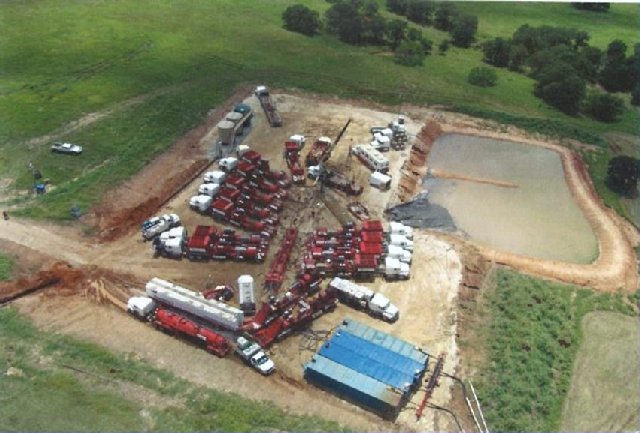
What the site may look like during the drilling and fracking process.

Neighborhood resident, Sara Barwinski explains,
 “What really concerns us is the massive increase of heavy industrialization on the site. This size of industrial complex is simply not appropriate next to a school and near homes. We are not calling for a ban on existing operations—we are just asking for balance, and for the city to apply their own criteria that requires new applications to be compatible with surrounding land uses.” 
Therese Gilbert with Weld Air and Water (WAW) agrees.
“Weld Air and Water became involved because we want to help Greeley understand the options they have to restore sanity in planning around oil and gas decisions. City Council members and City Staff have stated that because Greeley lost the effort to ban oil and gas drilling back in 1992 that they have “no choice” but to approve any and all requests to drill. This simply is not true.” 
 The appeal by neighbors and Weld Air and Water outlines legal arguments and suggests that Greeley adopt regulatory approaches that are commonly used by other local governments throughout Colorado. According to Gilbert,
  “Greeley needs to strike a better balance between the goals of the oil and gas industry and the health, safety and welfare of Greeley residents.” 
 The group believes there are hopeful signs that Greeley residents and leaders are seeing a need for more balanced decision-making.

Weld Air and Water is encouraged that the City Council passed a petition on July 16 to take a closer look at the impacts of these fuel storage tanks in neighborhoods and whether there should be restrictions in the number allowed.
“We don’t think the City should move forward with this application until that analysis has occurred,” Barwinski stated.
Susan Rutherford is one of the nearest neighbors to the site. Last spring her entire neighborhood woke to a loud, shrill noise at 3:00 in the morning.
“I finally was able to figure out that it was coming from the oil and gas site because I could see a smoky cloud and the air smelled like a hot furnace,” Rutherford stated.
She called 911 and the whole operation was soon shut down. She was informed by the operator that the problem was a faulty gas pressure release valve. Rutherford believed the problem should have been caught by more frequent inspections.
“There had been periodic unexplained noises going on all day long before it finally reached that critical point. ..How can anyone believe that approving that kind of danger is protecting our health and safety?” 
Residents are also upset that the city has ignored the impacts that enlarging this industrial complex would have on the Sheep Draw trail and wetlands, which has been home to bald eagles, horned owls, hawks and other wildlife.

Patricia Gonzalez, a neighbor in the immediate vicinity explains,
“We have already seen great impacts on wildlife caused from the existing wells. The day after the 3:00 am “wake-up call” incident, a pair of hawks abandoned their nest. I am also very concerned about the odors that have increased and the fact that I see less and less wildlife when I walk the trail.. 
This is an area that is considered of “high” ecological significance. It is zoned as a conservation district and is considered part of the Cache la Poudre River corridor. City code states: development should be rejected unless it would have ‘little or no impact’ on this area. An accidental spill will flow down-hill into this vulnerable watershed contaminating it.”  
Rutherford adds,
 “Greeley and our concerned citizens are spending dollars and manpower to connect this beautiful part of the Sheep Draw to the Poudre River Trail in 2014—why wouldn’t we want to protect this investment?” 
WAW’s Gilbert is a teacher and shares a further concern,
“The track and field of Northridge High School is just over 400 feet from the well-heads, so our kids will be deeply inhaling the fumes when they exercise. I am also worried about the lack of security at this unmanned facility.” 
Synergy had an uncontrolled release in Mead last month that required an emergency response at 2:00 a.m. Synergy stated that it suspects that it was caused by teens tampering with equipment. This and other similar incidents around the country have persuaded Weld Air and Water to put forward a number of recommendations for conditions that should be attached to the permit, should the City Council decide to approve it

Gilbert continued,
  “The 24/7 drilling, increased truck traffic, odors, dust and toxic emissions are clearly not ‘compatible’ with a neighborhood.” 
She pointed to the fact the City Council rejected a coffee-shop in a neighborhood last month because citizens’ voiced concerns about possible increased traffic and noise from the commercial facility.
 “Our city government needs to understand that they have both the authority and the obligation to regulate the impacts of this heavy industry whose impacts are far worse than the impacts of a coffee shop.” 
The appeal argues that the site fails all of the City’s criteria for appropriate development and is not consistent with Greeley’s Comprehensive Plan for the future. Barwinski stated,
“If it was any other industry besides oil and gas they wouldn’t think twice about rejecting it. We want them to take the time to think through their legal options and their responsibility to Greeley citizens before making a decision that will impact us for decades to come.” 

OIL AND GAS ACCIDENTS IN THE NEWS 
Large tank batteries have come under greater scrutiny because of a serious explosion at a natural gas drill site on July 7 in West Virginia—two people died and five others were injured. The accident is under federal and state investigation. The company that operates the drill site, Antero Resources, claims in its report issued by the West Virginia Department of Environmental Protection, that the cause of the blast was a buildup of gas in tanks used to store flow back water from the process of preparing the well for natural gas production.

The flow back process occurs during high-volume horizontal hydraulic fracturing—in which millions of gallons of water and chemicals are pumped deep underground to release natural gas from shale rock. According to the West Virginia Gazette, Antero said the accident was due to “the presence of an accumulation of gas from storage tanks on location.” The company also blamed “a concentration of heavier than methane hydrocarbons in the gas mixture” and “an apparent ignition source near” near the operation. 

The Chemical Safety Board (CSB), a federal agency, is encouraging local and state governments to take steps to protect young people from dangerous tank batteries related with oil and gas development. On October 31, 2009, two teenagers, aged 16 and 18, were killed when a storage tank containing natural gas condensate exploded at gas production site in Carnes, Mississippi. Six months later a group of youths were exploring a similar tank site in Weleetka, Oklahoma, when an explosion and fire fatally injured one individual. Two weeks later, a 25-year-old man and a 24-year-old woman were on top of an oil tank in New London, Texas, when the tank exploded, killing the woman and seriously injuring the man.

 The CSB deployed investigators to all three sites to collect information on the incidents. They concluded: “The introduction of an ignition source (such as a match, lighter, cigarette, or static electricity) near tank hatches or vents can trigger an internal tank explosion, often launching the tank into the air and killing or injuring people nearby, the CSB found in its October 2011 study of the problem. The study identified a total of 26 incidents since 1983 that killed 44 members of the public and injured 25 others all under the age of 25.

The CSB’s safety recommendations urged states, standards organizations, and trade associations, to take action to protect members of the public – particularly children and young adults – from these hazards.” For more information and a video on the risks to teens see Oil Site Safety. Synergy has stated that it believes that teen vandalism may have caused one of its gas wells near Mead to vent natural gas at 2:00am at a rate that sounded like “a giant over-sized air compressor” according to a neighbor. Source: Greeley Tribune in Brief, SHERIFF’S OFFICE INVESTIGATES POSSIBLE TAMPERING AT MEAD-AREA GAS WELL, Greeley Tribune July 27, 2013.

Sunday, July 28, 2013

Immediately Dangerous to Life or Health

First, I was concerned about the amounts of water used in fracking. Laced with various chemicals, some harmful, it's pumped by the millions of gallons into each well. When it comes back up it is even more toxic and polluted with heavy metals, hydrocarbons and sometimes radiation. No wonder this so-called produced water needs to be properly disposed of, although in Elbert County, they seem to think there's nothing wrong with throwing it onto dirt roads as dust mitigation. Read about that here.

Then, I began to worry about ground-level ozone, an air pollutant which is harmful when inhaled for prolonged periods, especially in children. According to Dr. Theo Colborn even one single ozone molecule can damage lung tissue. Children who have been exposed to lots of ozone pollution in their young years may in adolescence have brittle lungs that would resemble those of an 80-yr-old.

Ozone forms when hydro carbon emissions from oil condensate tanks, separators, and flares, react with sun light.. It is a serious health hazard to humans and animals, and can also negatively affects plants.
"There is evidence of significant reduction in agricultural yields because of increased ground-level ozone and pollution which interferes with photosynthesis and stunts overall growth of some plant species." See Ground-Level Ozone, a document by the World Bank Group International Finance Corporation.
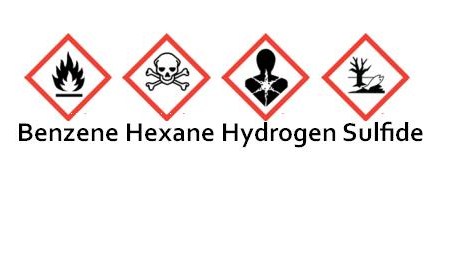
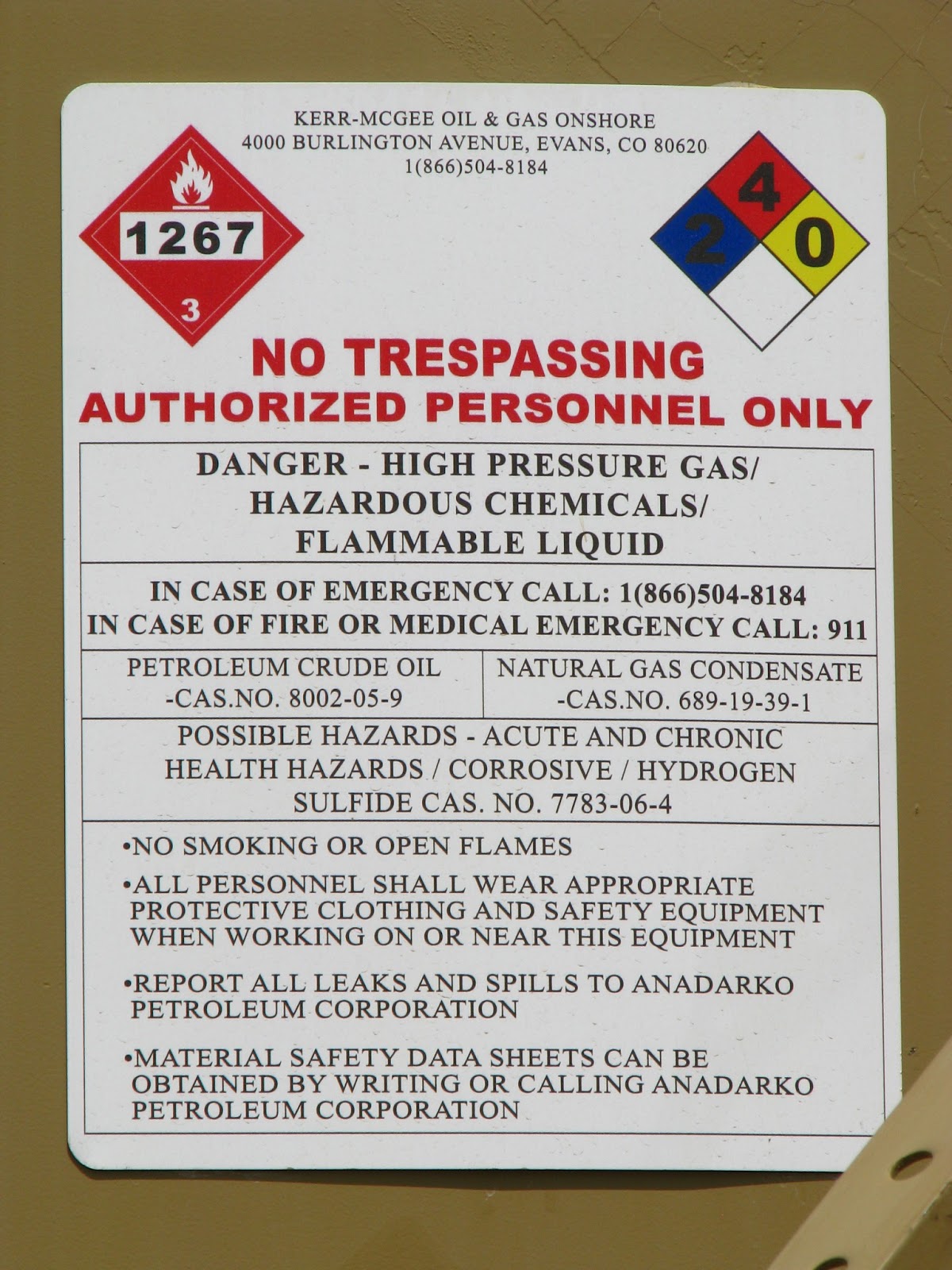
And as if the danger of high ozone levels is not serious enough, I then learned about the danger of H(2)S; hydrogen sulfide, a by-product of gas extraction. I had seen this chemical listed in warnings on some of the separators I photographed, but did not grasp its danger. After all, if any of these gas and oil well installations pose a serious hazard why are they allowed to be in residential areas?


I also began to worry about the fumes that are coming from gas wells. Especially when it is cool you can catch whiffs while passing by. Some remind me of petroleum, others are more indistinct, but smelling means inhaling and that surely cannot be good for your health! 

When I walked along the Sheep Draw trail with my daughter we caught some whiffs too. We were sure they came from the Northridge gas wells, not from the stream or marsh. Talking to a man who lives nearby, who mentioned he sometimes notices smells too, confirmed it for us. Now the question is, what did we smell? It was too fleeting to tell, but one of the whiffs did remind me of rotten eggs, which is precisely the smell of Hydrogen Sulfide, H(2)S

Here's the scary part! 
"H(2)S is an extraordinary poisonous gas. At low concentrations it has the odor of rotten eggs, but at higher, lethal concentrations, it is odorless. It is hazardous to workers and a few seconds of exposure at relatively low concentrations can be lethal." ~ Schlumberger Oil Field Glossary
In this OSHA document Respiratory Protection Requirements for Sour Crude Oil Tank Gauging Operations, it states,

"Where the gauging of sour crude oil tanks is concerned, air monitoring must be performed prior to each gauging operation, unless the weight percentage of H(2)S in the liquid crude is low enough that there is no potential for exposure above the Permissible Exposure Limit 
Tank gauging requires an employee to climb to the top of the storage tank, open a thief hatch, and determine the tank level by means of a plumb bob. Crude oil temperature and specific gravity readings may also be taken at this time, which would involve taking a sample from the tank and/or reading a gauge. Normally, the entire procedure takes approximately five to ten minutes. Hydrogen sulfide exposure during the gauging operation occurs when the thief hatch is opened. 
If air monitoring is not performed prior to gauging and there is a significant concentration of H(2)S present in the crude oil, than the atmosphere surrounding the hatch opening must be assumed to be IDLH." 

Meaning: Immediately Dangerous to Life or Health

And yet, in certain areas there are dangerous amounts of H(2)S inside condensate tanks. In Parachute, Nobel Energy has 353 active wells; 312 with H(2)S. 
37 have levels that can cause eye irritation and 4 have high enough levels that can cause serious symptoms., including death. See: Summary of Hydrogen Sulfide 
Would that not pose a hazard to people living nearby if H(2)S were to escape?

Gas Wells Poisoning Children's Air

Excerpt from Huffington Post.

"If everything goes as planned, Angie Nordstrum's son may look out the window of his second-grade classroom at Red Hawk Elementary this fall and see a full-scale natural gas drilling operation. He and his classmates, Nordstrum noted, will then have no choice but to breathe emissions of volatile organic compounds (VOCs), benzene and other toxic pollutants -- even while they tend to a 1,500-square-foot organic garden at their LEED-certified school. "This is so disturbing on so many levels," said Nordstrum, of Erie, Colo. 

According to many public health experts, the natural and manmade chemicals released during drilling, hydraulic fracturing (or fracking) and reinjection steps are making more and more people sick. Adding to the concern are new findings showing the associated air pollution, and the dangers of exposure to very small doses of certain chemicals.

Developing fetuses and young children can be the most vulnerable to these effects. In addition to the pollutants, and the intense noise, a natural gas operation looks like a "Christmas tree on steroids," noted Nordstrum, a member of the grassroots group of parents, Erie Rising, which is battling the gas wells. "So much is being said in news about how this is the new clean fuel," she said. "It's not."

According to a new study in Colorado that sampled air quality over the course of three years, people living within a half-mile of an oil or gas well were exposed to a number of toxic chemicals including benzene, a known carcinogen. VOC levels measured five times the safety limit set by the U.S. Environmental Protection Agency.
 "For children, the potential cancer risk is a serious consideration. They are more sensitive, exposed at younger ages and for longer periods of time,"
said Lisa McKenzie, lead researcher on the study at the Colorado School of Public Health. McKenzie said the results also pointed to potentially significant respiratory and neurological effects. For children, this could mean more headaches, sore throats and asthma.
"Children are more sensitive to all of these pollutants, whether traditional ozone, dust or particulates caused by hydrocarbons leaking out of the wells or the diesel trucks carrying the materials," 
added Sonya Lunder, a senior analyst at the nonprofit Environmental Working Group, whose goal is to protect public health and the environment. Lunder called the new findings "sobering" and emphasized the need for further study. "There are an incredible number of other industrial chemicals involved," she said. But research is complicated by the fact that these chemicals tend to vary from well to well, with names and quantities not always disclosed by the fracking company.

 Erie's eight pending natural gas wells would sit close to not only Red Hawk, but another elementary school, a middle school and a day care center in the well-to-do suburb. Local parents are convinced that the hundreds of gas wells already scattered throughout town may be at least partly responsible for various ailments in local children like severe asthma, chronic sinusitis and stomach problems.

All three of April Beach's sons suffer from chronic conditions that appear to be triggered by the pollution. One night, after one of his frequent dizzy spells, her 7-year-old Jacob wanted some answers: "Why are they doing this to us? Why can't they make it stop?" Beach recounted.
 "I have this drive to not only protect my kids but to protect all the kids who don't have a voice in this. We need to stop allowing kids to be guinea pigs."  said Beach, founder of Erie Rising.
 The Beach family will soon be moving out of Erie. "We have to get away from here," said Beach, adding that the pending move may mean financial suicide since they can't sell their house.
"I couldn't sleep at night if I knew another family was sleeping in this house with kids."

Read full article here

Also see: Where do the children play?

Thursday, July 25, 2013

Driving Out of Greeley is Depressing!!!

Leaving Greeley from any road these days is depressing! No matter if you go north, south, east, or west you see gas wells with tanks, separators, and flares that visually pollute the farm fields. Today my son took me via a scenic road south to Denver to visit the zoo with his son, my 2-1/2 year-old grandson. The country side south of 49th street was lush, and green with acres of corn stalks. Simply beautiful, as long as you tell yourself to ignore all the gas wells and tanks, left and right....and that is hard to do.

Once we were headed south on U.S. 85 we saw many more oil condensate tanks, but also new sites in the making, with drill rigs, and others where fracking operations are in full swing; you can tell when you see a field full of semi truck sized compressors that are needed to pressurize the water as it gets pumped into the well.

Clearly not a pretty sight, but appalling and stressful, really! I thought visiting the zoo with my grandson would give me a reprieve from the concerns of fracking, and it did once we got there. But oblivion was not to last very long as I noticed with dismay that some exhibits are named after corporate sponsors!  There's the Toyota Elephant Passage, the Gates Wildlife Conservation Education Center, the Janus Gateway center, the Conoco Zoo Gardens., and ....shocker of them all?


On the Denver Zoo website it says that
"Anadarko Petroleum Corporation has supported Denver Zoo through Do At The Zoo and Brew At The Zoo sponsorships since 2008. Beginning in 2013, Anadarko greatly expanded their involvement by presenting Denver Zoo's 2013 Do At The Zoo event in addition to providing educational, live animal community outreach programming in Weld County."
They also state:
"A special thank you to these Corporations [Encana is one of them too!] for their significant contributions...Corporate sponsor dollars are critical to Denver Zoo. These dollars are used to assist in the direct care and support of Denver Zoo’s animals and allows Denver Zoo to further its mission. Through these sponsorships, Denver Zoo continues to thrive and to carry out wildlife conservation and education for our community [while on the outside petroleum corporations like Anadarko and Encana are destroying our countryside and poisoning the air we breathe]"
Thankfully Greeley is getting more and more negative press. Perhaps because of that there's a glimmer of hope, as,
"The Colorado Oil and Gas Commission said neighbors’ concerns are one reason it hasn’t approved the wells yet."
See the CBS 4 News report with video interview with Sara Barwinski in which they say, "The city of Greeley is widely known as an oil and gas town."