Showing posts with label Chemicals. Show all posts
Showing posts with label Chemicals. Show all posts
Sunday, July 3, 2016
24 Gas Wells Unanimously Approved Near Bella Elementary
Below is the full text of the Greeley Tribune article, with interesting parts emphasized in red and my comments added in orange.
County commissioners approve Extraction Oil and Gas project near Bella Romero Academy
Sidewalk or no sidewalk? Bella Romero Academy’s lack of sidewalks have been a hot-button issue for years. When the school went up in 2003, the city of Greeley, Greeley-Evans School District 6 and Weld County officials all took notice. Each agency believed another one was responsible for building a sidewalk. The school is just outside Greeley city limits. During a meeting last week, school board officials decided to ask the commissioners to require Extraction Oil and Gas to build a sidewalk while building a nearby oil and gas project. That didn’t go through. One county commissioner said she wouldn’t consider it. Commissioner Barbara Kirkmeyer reminded residents that Weld County attempted to seek a federal grant to build the sidewalk, but no one would pitch in for the funding match. “We were told ‘no’ by the city of Greeley and ‘no’ by the school district,” she sad. “I think they chose to neglect and do nothing for their students.” [What about all that oil revenue for the county and the city? Can some of that not be used to make a sidewalk? What about the oil companies' PR slogan that they want to be a good neighbor? Why would they not volunteer paying for the sidewalk?]
Residents trickled out of the hearing room rolling their eyes and shaking their heads in disappointment as Weld County leaders loudly lauded the oil and gas industry Wednesday. “We don’t have a democracy,” Greeley resident Maydean Worley told the board before she walked out of the ongoing meeting that drew about 100 residents to discuss a planned 24-well oil and gas structure that Extraction Oil and Gas had proposed in east Greeley. Commissioners thanked the industry for lifting its residents out of poverty and providing a brighter economic future for its workers.
Everyone was gathered at the Weld County administration building, 1150 O St., for a hearing on another contested urban oil and gas project. Extraction officials sought a special use permit that would allow the company to build a 24-well pad east of Greeley, near Bella Romero Academy 4-8 Campus, 1400 E. 20th St. The commissioners unanimously approved it. Extraction will build up to 24 wells on the northeast corner of Cherry Avenue and 24th Street. Because of its access to both oil and natural gas pipeline, electricity and air quality technology, it will be one of the safest sites in the country, said Blane Thingelstad, a petroleum engineer for the company.
Before the public comment session began, Chairman Mike Freeman urged speakers to stay on task, focusing on this specific project. Often, even during this meeting, speakers on both sides got caught up in general energy policy arguments. This is a land use hearing, so instead of enacting new laws, all commissioners do is decide whether the project is appropriate for the area. Nearby resident Barbara Flores pointed to her house on a projected map, showing how close it is to the project site. “I am definitely affected by this monstrosity,” she said.
Residents lamented the project for a multitude of reasons: health risks, especially for nearby school children, pollution and truck traffic. “As a teacher, this bothers me,” said Therese Gilbert, who teaches at Heath Middle School, 2223 16th St. in Greeley. Children’s bodies are still developing, and that makes their lungs and other organs more sensitive to pollution, she said. There are already eight wells in the area, and the project would only bring more. “This would make it 32 within 1,500 feet,” she said. “That is not OK to have that close to kids.”
Anne Curry-Sanchez, another Greeley resident, pointed out that although the school building is 1,300 feet from the well site, a playground is only about 500 feet away. The state in recent years bolstered its setback requirements, requiring oil and gas activity to be no closer to high-occupancy structures than 1,000 feet; oil and gas structures must be 500 feet away from low-occupancy structures, such as homes.
Wendy Highby is a co-founder of Weld Air and Water, an anti-oil and gas advocacy group for the county. She said weather will affect the levels of pollution near the school, and some days will be worse than others. “Like we have snow days, we would (need to) have high pollution days,” she said. “We are ignoring the public health risks.” It’s tough to pollute areas around here because of the state’s strict environmental regulations, Thingelstad said. “Colorado has some of the best air quality standards in the nation,” he said.
[I guess Thinglestad is not aware that elevated ozone levels are now the norm here? Access the information at the website of the Colorado Department for Public Health & Environment.It even has this real-time ozone monitoring map
Most residents raised another concern about the location: the streets. They’re worried about having heavy-duty trucks on the roads in the area during constructions and drilling. Not only do they lack sidewalks for Bella Romero students, they’re in bad shape. Alan Herman, who said he worked for the city of Evans in the streets department, lives in the neighborhood. “That road’s not anywhere close to any road standards,” he said. Cars almost have to drive off the pavement to make way for oncoming traffic in some areas.
Thinglestad touted many of the site’s features he said go above and beyond those regulations: advanced technology that catches any escaping vapors, cell phone apps that let rig operators know in real time if there’s a problem, thicker sound walls and electric access, which cuts the need for loud, diesel-running drilling rigs. “Noise, emissions, diesel traffic … has been mitigated here,” he said.
Worley was one of the residents who veered into overarching energy policy. “Everyone in Weld County has these chemicals in their body,” she told the board. She called it a case of social and environmental injustice. After many residents showed their anger and disappointment with the board — some with facial expressions, some with snarky remarks — after the public hearing session, the commissioners went off task, as well.
Commissioner Julie Cozad talked about the perceived battle between protection of nature and oil and gas projects. “My degree is in biology and chemistry,” she said. “I study these issues. I think there is a way for industry to coexist.” Many commissioners responded to accusations such as, “You wouldn’t want this in your community.” Three of the five commissioners said they do have oil and gas in their communities. “There’s been no less than 10 rigs in my area,” Commissioner Barbara Kirkmeyer said.
You can contact the commissioners here: Meet the Commissioners

Wednesday, May 20, 2015
Drilling in Evans Neighborhood
Noble Energy and other oil companies want people to believe they are caring stewards of the environment, as shown in this video. But how caring are they when they drill smack in the middle of this Evans, CO neighborhood, just 100 feet from the closest home, and 1,000 feet from Ann Heiman Elementary School? (Scroll down for photos)
 I doubt the people who live there knew that would be a possibility, because a well head existed before they moved in. Few people realize that putting in a new well is not the end of drilling. Often wells need to be stimulated into producing again with hazardous substances like hydrochloric and hydrofluoric acid; chemicals you do not want in your neighborhood! Plus, there is the danger of a blowout .
Of note too is this
Toxic vapors suspected in deaths of three Colorado oil and gas workers
The article stays mum on the likelihood that those deaths might be caused by dangerous hydrogen sulfide that can kill within minutes.

What happens when that gas escapes in large quantities? What if such a well has a blowout such as the one in China in 2003 that killed more than 200 people and hospitalized 4,000! See:
Tragedy of errors in Chongqing's gas blowout
And this!
Children can suffer DNA damage and illness from leaking sour gas several kilometres away, yet B.C. allows wells within 150 metres of schools
It is appalling and beyond the pale, especially when more and more findings show that less lethal gases that escape are really hazardous to people's health as well!


Noble Energy "Community Gardening" TV Commercial

Of note too is this
Toxic vapors suspected in deaths of three Colorado oil and gas workers
The article stays mum on the likelihood that those deaths might be caused by dangerous hydrogen sulfide that can kill within minutes.

What happens when that gas escapes in large quantities? What if such a well has a blowout such as the one in China in 2003 that killed more than 200 people and hospitalized 4,000! See:
Tragedy of errors in Chongqing's gas blowout
And this!
Children can suffer DNA damage and illness from leaking sour gas several kilometres away, yet B.C. allows wells within 150 metres of schools
It is appalling and beyond the pale, especially when more and more findings show that less lethal gases that escape are really hazardous to people's health as well!
Fracking may affect air quality, human health "People living or working near active natural gas wells may be exposed to certain pollutants at higher levels than the Environmental Protection Agency considers safe for lifetime exposure. Air pollution from fracking operations may pose an under-recognized health hazard to people living near them, the researchers concluded."(Photos: Robert Winkler)


 |
| West of 35th ave and north of 37th st, Evans. |
Monday, July 21, 2014
The Damage Done by Fracking
“At health clinics, we’re seeing nearby residents experiencing nausea, headaches and other symptoms linked to fracking pollution,” said David Brown, a toxicologist who has reviewed health data from Pennsylvania. “With billions of gallons of toxic waste coming each year, we’re just seeing the ‘tip of the iceberg’ in terms of health risks.”
The report measured key indicators of fracking threats across the country, including:

280 billion gallons of toxic wastewater generated in 2012—enough to flood all of Washington, DC, in a 22-foot deep toxic lagoon
450,000 tons of air pollution produced in one year
250 billion gallons of fresh water used since 2005
360,000 acres of land degraded since 2005
100 million metric tons of global warming pollution since 2005.
Fracking also inflicts other damage not quantified in the report—ranging from contamination of residential wells to ruined roads to earthquakes at disposal sites.
Reviewing the totality of this fracking damage, the report’s authors conclude:
Read more: Groundbreaking Report Calculates Damage Done by Fracking
280 billion gallons of toxic wastewater generated in 2012—enough to flood all of Washington, DC, in a 22-foot deep toxic lagoon
450,000 tons of air pollution produced in one year
250 billion gallons of fresh water used since 2005
360,000 acres of land degraded since 2005
100 million metric tons of global warming pollution since 2005.
Fracking also inflicts other damage not quantified in the report—ranging from contamination of residential wells to ruined roads to earthquakes at disposal sites.
Reviewing the totality of this fracking damage, the report’s authors conclude:
Given the scale and severity of fracking’s myriad impacts, constructing a regulatory regime sufficient to protect the environment and public health from dirty drilling—much less enforcing such safeguards at more than 80,000 wells, plus processing and waste disposal sites across the country—seems implausible.In states where fracking is already underway, an immediate moratorium is in order. In all other states, banning fracking is the prudent and necessary course to protect the environment and public health.
Read more: Groundbreaking Report Calculates Damage Done by Fracking
Tuesday, July 8, 2014
Parents Ask Community for Input Against Drilling Near School
A message from the Frontier Parent Group. Receive their Instruction Letter Action Alert with more information by emailing: fpg.parentgroup@gmail.com
"The new Mineral Resources proposal [to drill near Frontier Academy] is for 19 wells, 20 tanks and 19 separators. Plans show the site to be 1,512 ft from the school building and a little over 1,000 ft from the playground. On 6/16/14 Mineral Resources filed a location assessment permit (form 2a) with the COGCC – Colorado Oil and Gas Conservation Commission. This file is being reviewed by COGCC and is currently open for public comment.
 We are asking parents, concerned community members, grandparents, local business owners, people who shop at local businesses (the proposed well site is 586 ft away from Walmart), anyone concerned, to VOICE their CONCERNS to COGCC via their online comment form.
The only way we will be able to be effective is if people show their involvement and worries for this location. Please, if you have any concerns with this location, now is the time to voice it! Your comment will become part of the public record of the application. Your name and e-mail address, if entered, will not be visible to other public users.
Click on South Greeley Directional File # 400604803 to access it. After a few seconds you will be redirected to the correct page, then click on comment on the right, and then New Comment to add your own.
On 7/1/14 Mineral Resources filed for the USR (Use by Special Review) with the City of Greeley. The file is under review and a hearing date will be determined.

Please help us to protect our school and our community...
Our children deserve a safe, healthy, noise and pollutant free
environment to study and learn!
The only way we will be able to be effective is if people show their involvement and worries for this location. Please, if you have any concerns with this location, now is the time to voice it! Your comment will become part of the public record of the application. Your name and e-mail address, if entered, will not be visible to other public users.
The deadline for comment is July 28.
Click on South Greeley Directional File # 400604803 to access it. After a few seconds you will be redirected to the correct page, then click on comment on the right, and then New Comment to add your own.
On 7/1/14 Mineral Resources filed for the USR (Use by Special Review) with the City of Greeley. The file is under review and a hearing date will be determined.
Friday, June 27, 2014
Fracking Chemicals Disrupt Hormones
June 23, 2014 :"We don't know what the adverse health consequences might be in humans and animals exposed to these chemicals," Kassotis said, "but infants and children would be most vulnerable because they are smaller, and infants lack the ability to break down these chemicals."

... "Among the chemicals that the fracking industry has reported using most often, all 24 that we have tested block the activity of one or more important hormone receptors," said the study's presenting author, Christopher Kassotis, a PhD student at the University of Missouri, Columbia. "The high levels of hormone disruption by endocrine-disrupting chemicals (EDCs) that we measured, have been associated with many poor health outcomes, such as infertility, cancer and birth defects."
The results were presented Monday at the joint meeting of the International Society of Endocrinology and the Endocrine Society: ICE/ENDO 2014 in Chicago.
Source: Hormone-disrupting activity of fracking chemicals worse than initially found
See some of the chemicals used on the Haliburton site: Colorado: What's In The Fluids?
Note that each fracturing job uses several million gallons of water! So, that 'measly' 0.5% of actual frack fluid additives still contains thousands of gallons of chemicals!

Wednesday, April 23, 2014
Largest well site in Greeley city limits gets approval
There's no doubt in my mind that the planning commission approved the site for the 57 wells, because almost half of that number is already in operation, near the intersection of U.S. 34 with U.S. 85. What the members must have forgotten to consider is that this site will now emit an even higher concentration of VOC's so the area will be much more hazardous to the health of many people, and especially young children, living nearby!
Plus, there is Union Colony elementary school within one mile of it! Those parents now should be as outraged as the ones of Frontier are, and show up in droves at the City Council meeting to share their outrage before the council, as they have always done so far, will unanimously give the expansion its seal of approval!
Take a look here to view the site (A) in relation to the school (B): http://goo.gl/maps/RZN7O
These storage tanks are already in place, as are 28 separators representing the same number of well heads.


Here's the Greeley Tribune article:
Largest well site in Greeley city limits gets approval from Planning Commission
Plus, there is Union Colony elementary school within one mile of it! Those parents now should be as outraged as the ones of Frontier are, and show up in droves at the City Council meeting to share their outrage before the council, as they have always done so far, will unanimously give the expansion its seal of approval!
Take a look here to view the site (A) in relation to the school (B): http://goo.gl/maps/RZN7O
Sunday, March 23, 2014
Chance to Speak out Against Drill Site Near Frontier!

In April, the Greeley Planning Commission will very likely grant the permit that will impact you and your children’s health and safety, unless parents and residents show their outrage, and show up in large numbers to speak out against it!
April 22 at 1:15 p.m.
Council Chambers of the Lincoln Park Annex building,
919 7th St.
The Colorado Oil and Gas Conservation Commission already gave their approval to place up to 67 wells with 32 oil tanks, and 30 separators on the site! Click here. Make sure Greeley does not lend theirs!
Learn why you should be concerned about Oil & Gas drilling in your neighborhood, or by your children’s school, and speak out against drilling at the upcoming public hearing!
The proposed South Greeley Directional Project at 27th Ave. & 30th St. next to Frontier Academy and Walmart. Marker A is the location of the well bore.


19 wells
24 oil storage tanks (red dots)
19 separators (yellow stripes)
Also see: Where Do the Children Play
67 Gas Wells Planned Near Frontier School and Walmart
Last but not least, a recent health study shows:
"an association between density and proximity of natural gas wells within a 10-mile radius of maternal residence and prevalence of Congenital Heart Defects and possibly Neural Tube Defects. [Most children with neural tube defects die or experience serious disability.] Access the report here.
Notice on the photo below that even the kids at Brentwood Middle School are still only half a mile away from the toxic emissions!

Thursday, February 6, 2014
Oil and Gas Workers Not Protected Against Hazards
I have heard about this before, about workers not being fully informed of, or protected against, the hazards of dealing with toxic fumes and materials at fracking sites in Dr. Theo Colborn's 45 min. documentary:
What You Need to Know About Natural Gas Production
I asked my brother-in-law about her video, and the clip below. He's worked in the gas fields for decades, checking gas wells, and was recently diagnosed with asthma. He is now VP at a well completion (euphemism for fracking fluid) company. He responded with:
Description of the video:
"Randy Moyer, who trucked brine from wells to treatment plants and back to wells, now suffers from dizziness, blurred vision, headaches, difficulty breathing, swollen lips and appendages, and a fiery red rash that covered about 50 percent of his body.
The Portage resident believes he's sick from the chemicals in fracking fluid and from radiation exposure. He cites unsafe and unregulated working conditions on well sites, no oversight about safety clothing, breathing masks, or chemical suits. The sites are treated like any other construction site, all that's needed is a hardhat and goggles. But when working with radiation and toxic chemicals from deep underground, adverse health effects are never far behind."
What You Need to Know About Natural Gas Production
I asked my brother-in-law about her video, and the clip below. He's worked in the gas fields for decades, checking gas wells, and was recently diagnosed with asthma. He is now VP at a well completion (euphemism for fracking fluid) company. He responded with:
"..just watched the video and can't believe that this is what we are discussing. First of all the oilfield is mandated as well as most other entities by the Occupational Safety and Health Administration (OSHA). Do you really believe that OSHA would not be going crazy if this were true. we are the most regulated industry in the United States no matter what you hear or believe. If you do not believe it read the OSHA regs as they apply to the oilfield.
Pay close attention to the rules on confined space entry (which is what this gentleman is talking about when cleaning tanks or pits). Also in Weld County the emissions from all wells have to meet standards and as far as I know they do. I would encourage you to do real research instead of listening to Josh Fox or Matt Damon.
I consider this a waste of time when OSHA and the EPA apparently aren't credible but this gentleman is. I will tell you this, most of the people in this industry care more for the environment than you will ever know. We hunt, fish, hike and generally spend twice the time outdoors than most of the people you know. I can't change your mind and really don't care to, so I won't debate by e-mail. If you truly want to know the truth when we are together I would be more than glad to talk to you about it."And, this response by his wife:
"You people that sit around and read something on the internet and decide it's true because you really can't know whether it is or not are AMAZING when it comes to fracing, which is what it was called when we became familiar with it. DO NOT send me anything about what you have read or discovered or think you know about fracing. There are dozens of items in the grocery store that are more harmful to the environment than fracing, so chase some other ambulance. [My husband] is always open to teach and give correct information about fracing, it's his specialty. We shake our heads at what you people come up with when knowledge is as close as your phone. Just because you read it somewhere..."
What do you think? Is the man in this video telling lies?
Description of the video:
"Randy Moyer, who trucked brine from wells to treatment plants and back to wells, now suffers from dizziness, blurred vision, headaches, difficulty breathing, swollen lips and appendages, and a fiery red rash that covered about 50 percent of his body.
The Portage resident believes he's sick from the chemicals in fracking fluid and from radiation exposure. He cites unsafe and unregulated working conditions on well sites, no oversight about safety clothing, breathing masks, or chemical suits. The sites are treated like any other construction site, all that's needed is a hardhat and goggles. But when working with radiation and toxic chemicals from deep underground, adverse health effects are never far behind."
Saturday, February 1, 2014
Health Hazards of living near Oil and Gas Wells
How often have you heard people who work for Oil & Gas companies say,
I would like to know what they base that statement on. Dr. Wilma Subra in her presentation Human Health; Exposure from the Development of Shale Gas, notes that,
Watch her full presentation here

And then there's the issue of well water contamination by oil and gas drilling activities in Pavillion, Wyoming. The industry is not regulated when it comes to the protection of drinking water supplies either. Says Dan Rather in the second segment of his report:
In the report, rancher John Fenton says:
He hauls it in gallon jugs from the town, forty miles away. Because of their tainted well water they can no longer grow a garden, and when they launder or shower there needs to be ventilation because of the methane content in the water. In this different clip he says,
Access the report here.
"We are the most regulated industry in the United States"
I would like to know what they base that statement on. Dr. Wilma Subra in her presentation Human Health; Exposure from the Development of Shale Gas, notes that,
"Wastes generated by the exploration of crude oil and natural gas are 'exempt' by Federal law from being regulated as hazardous waste"
Watch her full presentation here
And then there's the issue of well water contamination by oil and gas drilling activities in Pavillion, Wyoming. The industry is not regulated when it comes to the protection of drinking water supplies either. Says Dan Rather in the second segment of his report:
"Even though the agency is mandated by the Safe Drinking Water Act to monitor the quality of the drinking water across the United States, the EPA has been restricted from testing water near oil and gas fracking sites. That's because the oil and gas industry had some help from Congress in the Bush administration. In the summer of 2005 Congress passes, and president Bush signed the Energy Policy Act. In that bill was a provision that excludes Oil and Gas Companies from the drinking water regulation. It is the only industry to have such an exclusion"Watch: Dan Rather Reports, "Fracking Gas"
In the report, rancher John Fenton says:
"You don't know how precious water is until you have to start buying it...It's either this or drink water with an unknown toxic chemical in it."
He hauls it in gallon jugs from the town, forty miles away. Because of their tainted well water they can no longer grow a garden, and when they launder or shower there needs to be ventilation because of the methane content in the water. In this different clip he says,
"We've done our own sort of health assessment with the help of a woman named Dr. Wilma Subra....She compiled the information for us. And there are some real common problems between the people who have health symptoms: nose bleeds, lack of smell and taste, headaches, dizziness, neuropathy. You know, no matter where you go, people living in close proximity to this, have the same problems..It affects all humans the same no matter where you are from."
Last but not least, a recent health study shows:
"an association between density and proximity of natural gas wells within a 10-mile radius of maternal residence and prevalence of Congenital Heart Defects and possibly Neural Tube Defects. [Most children with neural tube defects die or experience serious disability.]
Access the report here.
Friday, August 30, 2013
Greeley must protect quality of life for residents
By Therese Gilbert
I seldom see the Rockies clearly from Greeley anymore. My sisters, during their visit two weeks ago, noticed this as well. Having grown up in Colorado and now living out of state, they look forward to seeing that beautiful and familiar vista to the west. What accounts for this gray-brown haze on blue-sky days? We can’t possibly match the traffic level of metro Denver, so what could be contributing to this poor air quality?
Within the last 10 years, there has been an accelerated rate of oil and gas development in Weld County. While the industry has brought in some revenue and created jobs, the cumulative effect of this drilling on our air quality is now becoming apparent. We currently have over 20,000 active wells in Weld County, and new additional drilling projects, already permitted by the state, will soon close the “donut hole” within city limits.

Drilling within the center of Greeley has been last for obvious reasons; the risks of such development are simply not compatible with the quality of life that most residents consider acceptable. Since March of this year, over 181 wells were permitted to drill, many within 500 feet of schools.
The process of hydraulic fracturing involves adding over 600 chemicals to 2-10 million gallons of clean water and sand per well, and the mixture is injected with great force to open up rock fissures underground that allow natural gas to escape and be captured on the surface. The gas is collected in the large, cylindrical, beige colored tanks that blotch our landscape.

If unsightliness were the worst feature of these tanks, we might have reason to complain, but little to worry us. However, what we don’t see is the problem. Toxic gases such as benzene, ethylbenzene, xylene, ethane, toluene, and others leak from these condensate tanks, some of which cause cancer and respiratory illnesses. The highest industry standard allows for 2% of the gases to escape, but it is estimated that many leak more than 5%.

Now, imagine the cumulative effect of over 20,000 wells leaking 5% of their toxic gases! Most emissions escape during the initial drilling process, and according to one study, those living within half a mile of natural gas wells are at the highest risk for exposure. (2012 Colorado School of Public Health, University of Colorado – McKenzie, Witter, Newman, Adgate)
A recent study has found that oil & gas production in Weld County contributes 55% of the VOC’s (volatile organic compounds) that cause ozone pollution in the northern Colorado region, and for the past 2 years the air in Weld County has been out of compliance with federal standards for ground level ozone. (2013 Cooperative Institute for Research in Environmental Sciences – Gilman, et al)

As residents of Weld County and Greeley, we are surrounded with the consequences of this heavy industrialization every day. The latest project by Synergy Corporation proposes to add 12 horizontal wells and 25 condensate tanks to a site within 450 feet of the track at Northridge High School where students exercise. Is this responsible development?
I seldom see the Rockies clearly from Greeley anymore. My sisters, during their visit two weeks ago, noticed this as well. Having grown up in Colorado and now living out of state, they look forward to seeing that beautiful and familiar vista to the west. What accounts for this gray-brown haze on blue-sky days? We can’t possibly match the traffic level of metro Denver, so what could be contributing to this poor air quality?
Within the last 10 years, there has been an accelerated rate of oil and gas development in Weld County. While the industry has brought in some revenue and created jobs, the cumulative effect of this drilling on our air quality is now becoming apparent. We currently have over 20,000 active wells in Weld County, and new additional drilling projects, already permitted by the state, will soon close the “donut hole” within city limits.

Drilling within the center of Greeley has been last for obvious reasons; the risks of such development are simply not compatible with the quality of life that most residents consider acceptable. Since March of this year, over 181 wells were permitted to drill, many within 500 feet of schools.
|
| Behind Frontier Academy and Walmart 67 wells are planned. The red dot is where the drill rig will be placed; the dots and yellow stripes at the bottom are storage tanks and separators. |
The process of hydraulic fracturing involves adding over 600 chemicals to 2-10 million gallons of clean water and sand per well, and the mixture is injected with great force to open up rock fissures underground that allow natural gas to escape and be captured on the surface. The gas is collected in the large, cylindrical, beige colored tanks that blotch our landscape.

If unsightliness were the worst feature of these tanks, we might have reason to complain, but little to worry us. However, what we don’t see is the problem. Toxic gases such as benzene, ethylbenzene, xylene, ethane, toluene, and others leak from these condensate tanks, some of which cause cancer and respiratory illnesses. The highest industry standard allows for 2% of the gases to escape, but it is estimated that many leak more than 5%.
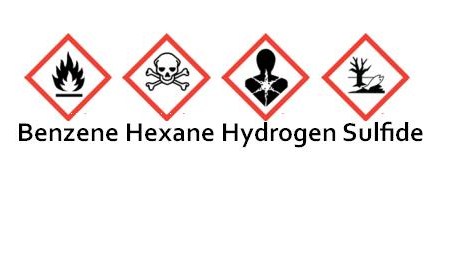
Now, imagine the cumulative effect of over 20,000 wells leaking 5% of their toxic gases! Most emissions escape during the initial drilling process, and according to one study, those living within half a mile of natural gas wells are at the highest risk for exposure. (2012 Colorado School of Public Health, University of Colorado – McKenzie, Witter, Newman, Adgate)
A recent study has found that oil & gas production in Weld County contributes 55% of the VOC’s (volatile organic compounds) that cause ozone pollution in the northern Colorado region, and for the past 2 years the air in Weld County has been out of compliance with federal standards for ground level ozone. (2013 Cooperative Institute for Research in Environmental Sciences – Gilman, et al)

As residents of Weld County and Greeley, we are surrounded with the consequences of this heavy industrialization every day. The latest project by Synergy Corporation proposes to add 12 horizontal wells and 25 condensate tanks to a site within 450 feet of the track at Northridge High School where students exercise. Is this responsible development?
Should we be risking the health of those who must live so close to this drilling?
We were given this beautiful planet to call our home, and we must be responsible stewards of this gift. A healthy environment is a safe home; let us be careful in making choices that might forever damage the precious air we breathe. I urge our city council to make decisions that not only protect the rights of mineral owners, but protect the quality of life for those of us living and breathing on the surface.
Thursday, August 15, 2013
French Film Crew in Greeley in Search of Fracking
"Would you want to meet with a french film crew, and help show them around? They want to do a film on fracking in Weld."
That was the message I found in my inbox yesterday. "Heck, yes! Of course I wanted to show them around! Let's get word and video out to the world beyond our city limits, and borders, of how dreadful the oil & gas installation infestation has become here! When was the last time we had a clear view of the mountains?
Unfortunately I forgot to take along my photo camera, and cannot show that I and two others actually did meet the crew. It was six o'clock when they finally arrived at the Kress theater where we'd been waiting for almost an hour. It turns out they'd been wandering around up north, near Grover!
After introductions I asked Herve and Pierre, "Did you see a lot of gas wells and oil tanks on the way here?" "Yes", Herve said, "but we want to see fracking" . "But that all is fracking!" I told them, but it turns out they wanted to see the actual process where the water goes in or comes back out. They were looking for a site with lots of trucks and compressors.
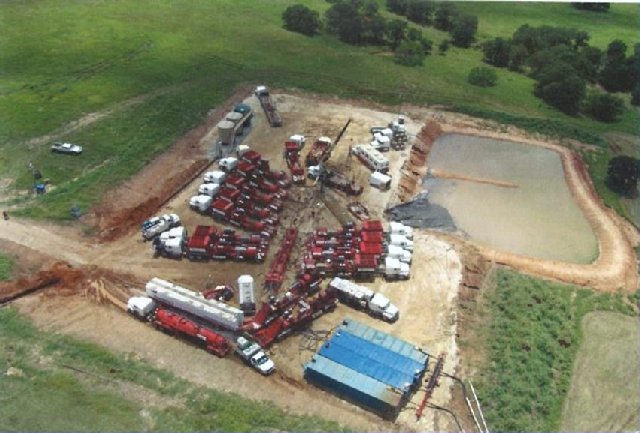
"No such thing going on around here for the moment," I told them. "Your best bet is to find active sites along U.S. 85". And so, after having spent just 10 minutes in our well infested city, they left again.
We thought they had wanted to see the various gas well sites near houses and water, but they were not interested in the effects after drilling and fracking is completed, and that it is the emissions from the installations that pose the largest and most immediate danger to people's health.
 |
| Near Riverside Park, Evans |

Granted, a field filled with trucks and compressors looks more impressive and obnoxious than the tanks and separators neatly painted in sand color to blend into the surroundings, but it is precisely these that are dangerous and noxious, and remain so! The fracking process is bad and poses real hazards, but let's not forget that after fracking, residents will still be inhaling noxious fumes!
Sunday, July 28, 2013
Immediately Dangerous to Life or Health
First, I was concerned about the amounts of water used in fracking. Laced with various chemicals, some harmful, it's pumped by the millions of gallons into each well. When it comes back up it is even more toxic and polluted with heavy metals, hydrocarbons and sometimes radiation. No wonder this so-called produced water needs to be properly disposed of, although in Elbert County, they seem to think there's nothing wrong with throwing it onto dirt roads as dust mitigation. Read about that here.
Then, I began to worry about ground-level ozone, an air pollutant which is harmful when inhaled for prolonged periods, especially in children. According to Dr. Theo Colborn even one single ozone molecule can damage lung tissue. Children who have been exposed to lots of ozone pollution in their young years may in adolescence have brittle lungs that would resemble those of an 80-yr-old.
Ozone forms when hydro carbon emissions from oil condensate tanks, separators, and flares, react with sun light.. It is a serious health hazard to humans and animals, and can also negatively affects plants.


I also began to worry about the fumes that are coming from gas wells. Especially when it is cool you can catch whiffs while passing by. Some remind me of petroleum, others are more indistinct, but smelling means inhaling and that surely cannot be good for your health!
When I walked along the Sheep Draw trail with my daughter we caught some whiffs too. We were sure they came from the Northridge gas wells, not from the stream or marsh. Talking to a man who lives nearby, who mentioned he sometimes notices smells too, confirmed it for us. Now the question is, what did we smell? It was too fleeting to tell, but one of the whiffs did remind me of rotten eggs, which is precisely the smell of Hydrogen Sulfide, H(2)S
Here's the scary part!
Then, I began to worry about ground-level ozone, an air pollutant which is harmful when inhaled for prolonged periods, especially in children. According to Dr. Theo Colborn even one single ozone molecule can damage lung tissue. Children who have been exposed to lots of ozone pollution in their young years may in adolescence have brittle lungs that would resemble those of an 80-yr-old.
Ozone forms when hydro carbon emissions from oil condensate tanks, separators, and flares, react with sun light.. It is a serious health hazard to humans and animals, and can also negatively affects plants.
"There is evidence of significant reduction in agricultural yields because of increased ground-level ozone and pollution which interferes with photosynthesis and stunts overall growth of some plant species." See Ground-Level Ozone, a document by the World Bank Group International Finance Corporation.And as if the danger of high ozone levels is not serious enough, I then learned about the danger of H(2)S; hydrogen sulfide, a by-product of gas extraction. I had seen this chemical listed in warnings on some of the separators I photographed, but did not grasp its danger. After all, if any of these gas and oil well installations pose a serious hazard why are they allowed to be in residential areas?

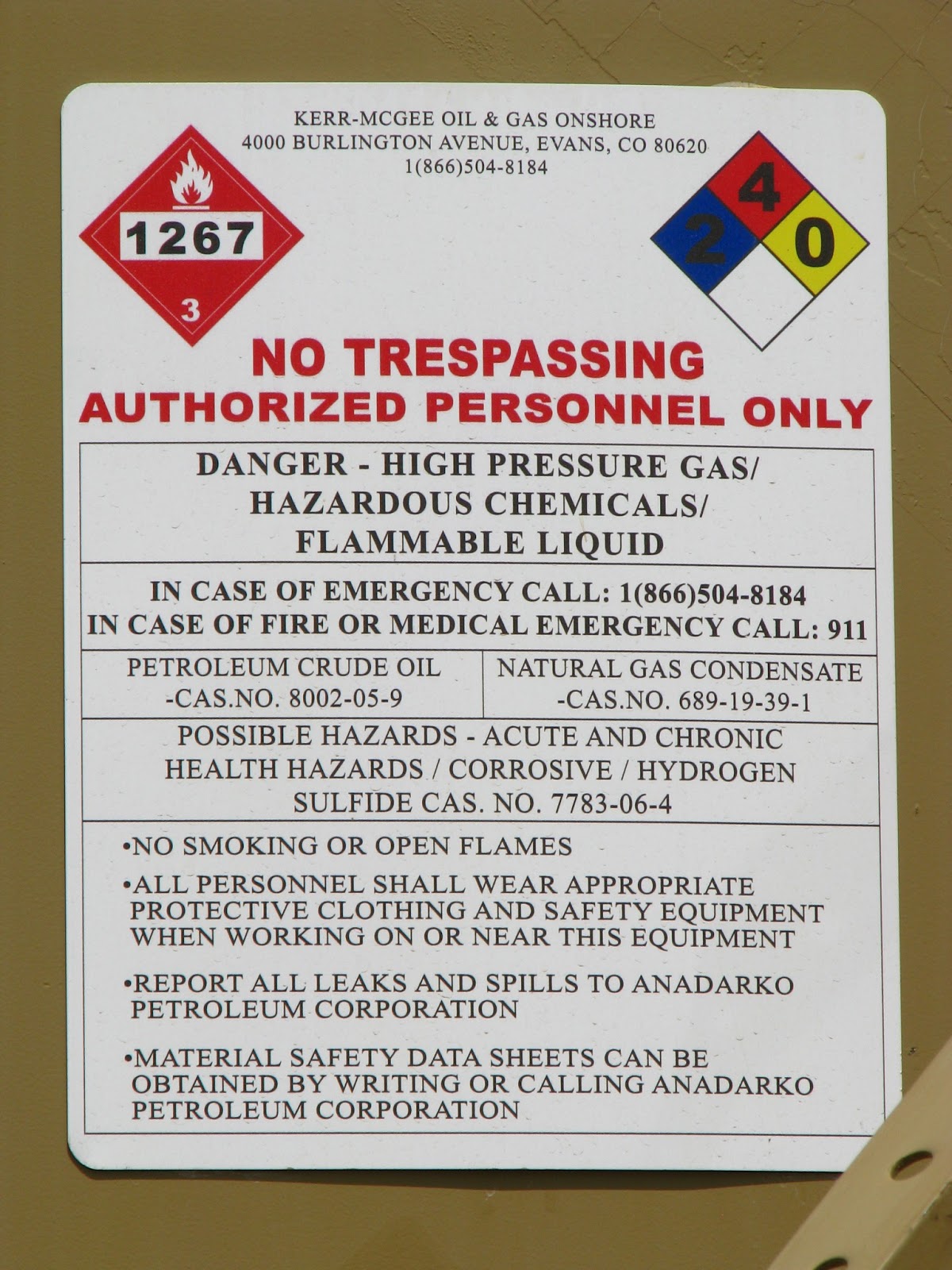
I also began to worry about the fumes that are coming from gas wells. Especially when it is cool you can catch whiffs while passing by. Some remind me of petroleum, others are more indistinct, but smelling means inhaling and that surely cannot be good for your health!
When I walked along the Sheep Draw trail with my daughter we caught some whiffs too. We were sure they came from the Northridge gas wells, not from the stream or marsh. Talking to a man who lives nearby, who mentioned he sometimes notices smells too, confirmed it for us. Now the question is, what did we smell? It was too fleeting to tell, but one of the whiffs did remind me of rotten eggs, which is precisely the smell of Hydrogen Sulfide, H(2)S
Here's the scary part!
"H(2)S is an extraordinary poisonous gas. At low concentrations it has the odor of rotten eggs, but at higher, lethal concentrations, it is odorless. It is hazardous to workers and a few seconds of exposure at relatively low concentrations can be lethal." ~ Schlumberger Oil Field GlossaryIn this OSHA document Respiratory Protection Requirements for Sour Crude Oil Tank Gauging Operations, it states,
"Where the gauging of sour crude oil tanks is concerned, air monitoring must be performed prior to each gauging operation, unless the weight percentage of H(2)S in the liquid crude is low enough that there is no potential for exposure above the Permissible Exposure Limit.
Tank gauging requires an employee to climb to the top of the storage tank, open a thief hatch, and determine the tank level by means of a plumb bob. Crude oil temperature and specific gravity readings may also be taken at this time, which would involve taking a sample from the tank and/or reading a gauge. Normally, the entire procedure takes approximately five to ten minutes. Hydrogen sulfide exposure during the gauging operation occurs when the thief hatch is opened.
If air monitoring is not performed prior to gauging and there is a significant concentration of H(2)S present in the crude oil, than the atmosphere surrounding the hatch opening must be assumed to be IDLH."
Meaning: Immediately Dangerous to Life or Health
And yet, in certain areas there are dangerous amounts of H(2)S inside condensate tanks. In Parachute, Nobel Energy has 353 active wells; 312 with H(2)S.37 have levels that can cause eye irritation and 4 have high enough levels that can cause serious symptoms., including death. See: Summary of Hydrogen SulfideWould that not pose a hazard to people living nearby if H(2)S were to escape?
Thursday, May 23, 2013
What is Fracking? Why is it Bad?
Fracking is the name for extracting oil and gas by injecting millions of gallons of highly pressurized water, sand and chemicals, into a well-bore, after charges have blasted open the first cracks in the rock. As the solution is pumped in, it makes more cracks, hence, the name hydraulic fracturing.
Watch this 2 min. animation: Horizontal Drilling and Hydraulic Fracturing
Fracking can cause serious side-effects to the immediate environment. Once the oil and gas have been removed, the sandstone or shale rock base is left with gaps that make the bedrock unstable. Gas companies try to fill those cracks with sand or other particulates to keep the cracks from collapsing, but that doesn’t always help.
In areas where the fracking is done far below the surface, cracks are nearly impossible to fill. They can cause minor earthquakes, which in turn can damage the cement casings of the wells so gas and oil can seep out and contaminate aquifers. It doesn’t take a genius to recognize the health risks associated with the presence of oil in the water table. Cancer and other illnesses are common in areas of high fracking activity.
Water Use
Toxic Chemicals
Sand and Proppants
Air Quality
Waste Water
Learn lots more, especially also about the type of Toxic Chemicals used and/or released with fracking by visiting: Hydraulic Fracturing 101
Watch this 2 min. animation: Horizontal Drilling and Hydraulic Fracturing
Fracking can cause serious side-effects to the immediate environment. Once the oil and gas have been removed, the sandstone or shale rock base is left with gaps that make the bedrock unstable. Gas companies try to fill those cracks with sand or other particulates to keep the cracks from collapsing, but that doesn’t always help.
In areas where the fracking is done far below the surface, cracks are nearly impossible to fill. They can cause minor earthquakes, which in turn can damage the cement casings of the wells so gas and oil can seep out and contaminate aquifers. It doesn’t take a genius to recognize the health risks associated with the presence of oil in the water table. Cancer and other illnesses are common in areas of high fracking activity.
Water Use
- In 2010, the U.S. Environmental Protection Agency estimated that 70 to 140 billion gallons of water are used to fracture 35,000 wells in the United States each year. This is approximately the annual water consumption of 40 to 80 cities each with a population of 50,000.
- It has been estimated that the transportation of 1 million gallons of water requires 200 truck trips. Deep, horizontal wells can use 2 to 10 million gallons of water to fracture a single well. That is 400 to 2000 truck trips! So, not only does water used for hydraulic fracturing deplete fresh water supplies and impact aquatic habitat, the transportation of so much water also creates localized air quality, safety and road repair issues.
Toxic Chemicals
- A variety of chemicals are used in hydraulic fracturing fluids. The oil and gas industry and trade groups are quick to point out that chemicals typically make up just 0.5 and 2.0% of the total volume of the fracturing fluid. But, when millions of gallons of water are being used, the amount of those chemicals per fracking operation is very large. For example, four million gallons of water for one fracturing operation would use 80 to 330 tons of chemicals.
Sand and Proppants
- Shale gas wells can use more than 4 million pounds of proppant per well. Frac sand mines are springing up across the country, from Wisconsin to Texas, bringing with them their own set of impacts. Mining sand for proppant use generates its own range of impacts, including water consumption and air emissions, as well as potential health problems related to crystalline silica.
Air Quality
- In many oil and gas producing regions, there has been a degradation of air quality as drilling increases. In Texas, high levels of benzene have been measured in the air near wells in the Barnett Shale gas fields. These volatile air toxics may be originating from a variety of gas-field sources such as separators, dehydrators, condensers, compressors, chemical spills, and leaking pipes and valves.
Waste Water
- Increasingly, research is being conducted on the potential air emissions released during the fracturing flow back stage, when wastewater returns to the surface. Shales contain numerous organic hydrocarbons, and additional chemicals are injected underground during shale gas drilling, well stimulation (e.g., hydraulic fracturing), and well workovers.
- The Pittsburgh University Center for Healthy Environments and Communities (CHEC) has been examining how organic compounds in the shale can be mobilized during fracturing and gas extraction processes...These organic compounds are brought to the surface in the fracturing flowback or produced water, and often go into open impoundments (frac ponds), where the waste water, “will offgas its organic compounds into the air. This becomes an air pollution problem, and the organic compounds are now termed Hazardous Air Pollutants (HAP’s).”
Learn lots more, especially also about the type of Toxic Chemicals used and/or released with fracking by visiting: Hydraulic Fracturing 101
Subscribe to:
Posts (Atom)