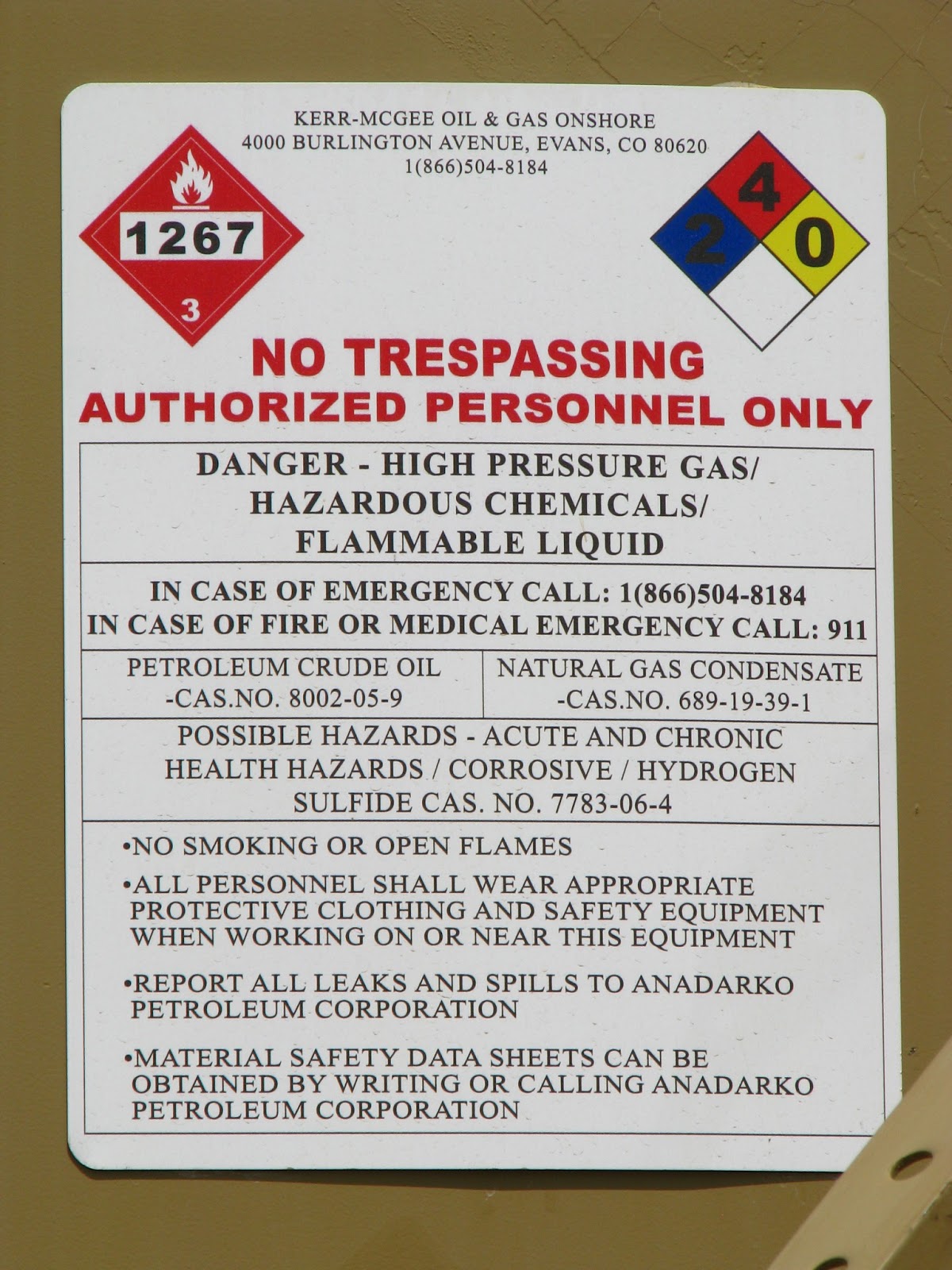
First, I was concerned about the amounts of water used in fracking. Laced with various chemicals, some harmful, it's pumped by the millions of gallons into each well. When it comes back up it is even more toxic and polluted with heavy metals, hydrocarbons and sometimes radiation. No wonder this so-called produced water needs to be properly disposed of, although in Elbert County, they seem to think there's nothing wrong with throwing it onto dirt roads as dust mitigation. Read about that here.
Then, I began to worry about ground-level ozone,
an air pollutant which is harmful when inhaled for prolonged periods, especially in children. According to Dr. Theo Colborn even one single ozone molecule can damage lung tissue. Children who have been exposed to lots of ozone pollution in their young years may in adolescence have brittle lungs that would resemble those of an 80-yr-old.
Ozone forms when hydro carbon emissions from oil condensate tanks, separators, and flares, react with sun light.. It is a serious health hazard to humans and animals, and can also negatively affects plants.
"There is evidence of significant reduction in agricultural yields because of increased ground-level ozone and pollution which interferes with photosynthesis and stunts overall growth of some plant species." See Ground-Level Ozone, a document by the World Bank Group International Finance Corporation.
And as if the danger of high ozone levels is not serious enough, I then learned about the danger of H(2)S; hydrogen sulfide, a by-product of gas extraction. I had seen this chemical listed in warnings on some of the separators I photographed, but did not grasp its danger. After all, if any of these gas and oil well installations pose a serious hazard why are they allowed to be in residential areas?
 I also began to worry about the fumes that are coming from gas wells. Especially when it is cool you can catch whiffs while passing by. Some remind me of petroleum, others are more indistinct, but smelling means inhaling and that surely cannot be good for your health!
When I walked along the Sheep Draw trail with my daughter we caught some whiffs too. We were sure they came from the Northridge gas wells, not from the stream or marsh. Talking to a man who lives nearby, who mentioned he sometimes notices smells too, confirmed it for us. Now the question is, what did we smell? It was too fleeting to tell, but one of the whiffs did remind me of rotten eggs, which is precisely the smell of Hydrogen Sulfide, H(2)S
Here's the scary part!
"H(2)S is an extraordinary poisonous gas. At low concentrations it has the odor of rotten eggs, but at higher, lethal concentrations, it is odorless. It is hazardous to workers and a few seconds of exposure at relatively low concentrations can be lethal." ~ Schlumberger Oil Field Glossary
In this OSHA document Respiratory Protection Requirements for Sour Crude Oil Tank Gauging Operations, it states,
"Where the gauging of sour crude oil tanks is concerned, air monitoring must be performed prior to each gauging operation, unless the weight percentage of H(2)S in the liquid crude is low enough that there is no potential for exposure above the Permissible Exposure Limit.
Tank gauging requires an employee to climb to the top of the storage tank, open a thief hatch, and determine the tank level by means of a plumb bob. Crude oil temperature and specific gravity readings may also be taken at this time, which would involve taking a sample from the tank and/or reading a gauge. Normally, the entire procedure takes approximately five to ten minutes. Hydrogen sulfide exposure during the gauging operation occurs when the thief hatch is opened.
If air monitoring is not performed prior to gauging and there is a significant concentration of H(2)S present in the crude oil, than the atmosphere surrounding the hatch opening must be assumed to be IDLH."
Meaning: Immediately Dangerous to Life or Health
And yet, in certain areas there are dangerous amounts of H(2)S inside condensate tanks. In Parachute, Nobel Energy has 353 active wells; 312 with H(2)S.
37 have levels that can cause eye irritation and 4 have high enough levels that can cause serious symptoms., including death. See: Summary of Hydrogen Sulfide
Would that not pose a hazard to people living nearby if H(2)S were to escape?