Sunday, July 28, 2013

Immediately Dangerous to Life or Health

First, I was concerned about the amounts of water used in fracking. Laced with various chemicals, some harmful, it's pumped by the millions of gallons into each well. When it comes back up it is even more toxic and polluted with heavy metals, hydrocarbons and sometimes radiation. No wonder this so-called produced water needs to be properly disposed of, although in Elbert County, they seem to think there's nothing wrong with throwing it onto dirt roads as dust mitigation. Read about that here.

Then, I began to worry about ground-level ozone, an air pollutant which is harmful when inhaled for prolonged periods, especially in children. According to Dr. Theo Colborn even one single ozone molecule can damage lung tissue. Children who have been exposed to lots of ozone pollution in their young years may in adolescence have brittle lungs that would resemble those of an 80-yr-old.

Ozone forms when hydro carbon emissions from oil condensate tanks, separators, and flares, react with sun light.. It is a serious health hazard to humans and animals, and can also negatively affects plants.
"There is evidence of significant reduction in agricultural yields because of increased ground-level ozone and pollution which interferes with photosynthesis and stunts overall growth of some plant species." See Ground-Level Ozone, a document by the World Bank Group International Finance Corporation.
And as if the danger of high ozone levels is not serious enough, I then learned about the danger of H(2)S; hydrogen sulfide, a by-product of gas extraction. I had seen this chemical listed in warnings on some of the separators I photographed, but did not grasp its danger. After all, if any of these gas and oil well installations pose a serious hazard why are they allowed to be in residential areas?

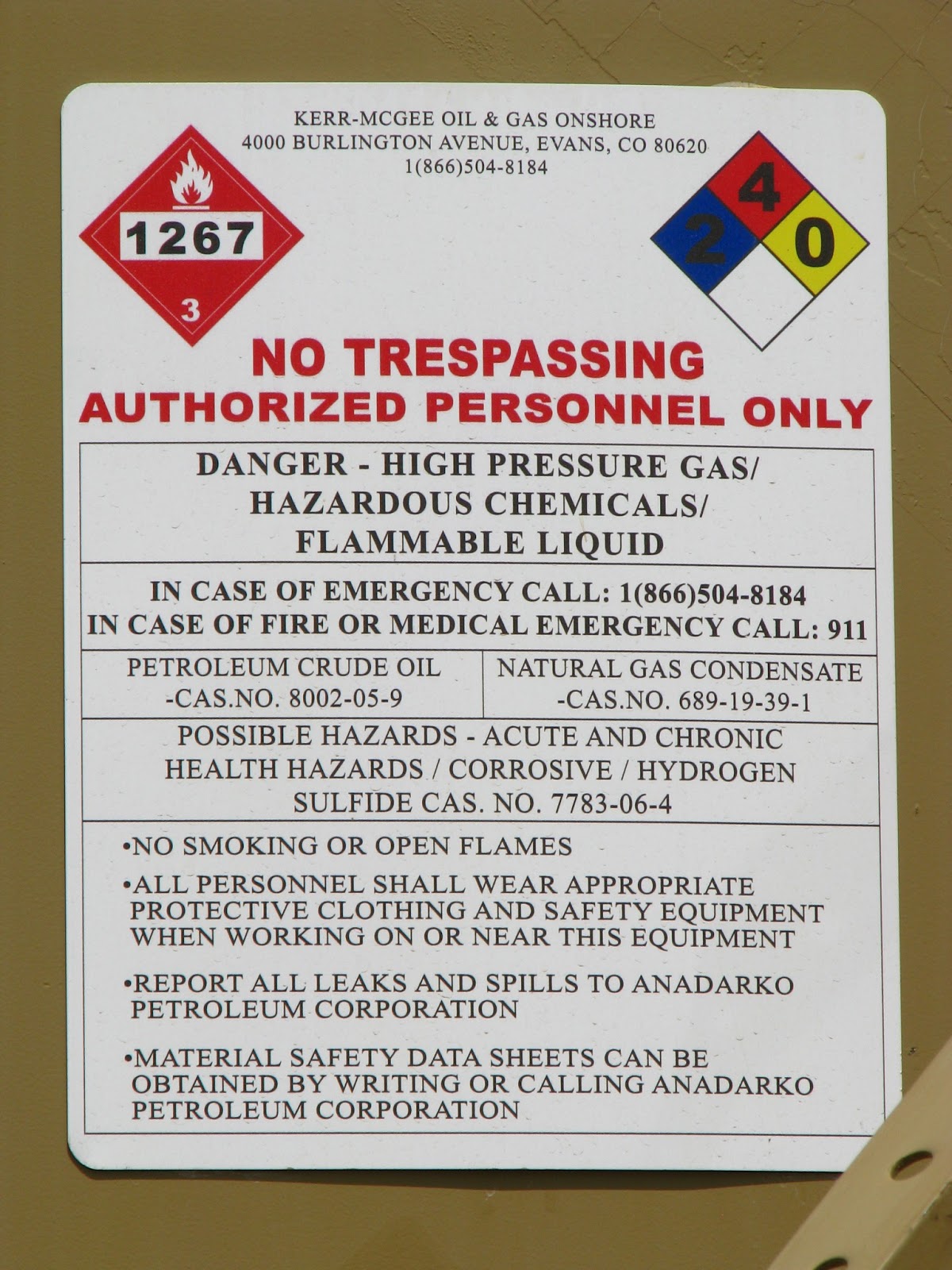


I also began to worry about the fumes that are coming from gas wells. Especially when it is cool you can catch whiffs while passing by. Some remind me of petroleum, others are more indistinct, but smelling means inhaling and that surely cannot be good for your health! 

When I walked along the Sheep Draw trail with my daughter we caught some whiffs too. We were sure they came from the Northridge gas wells, not from the stream or marsh. Talking to a man who lives nearby, who mentioned he sometimes notices smells too, confirmed it for us. Now the question is, what did we smell? It was too fleeting to tell, but one of the whiffs did remind me of rotten eggs, which is precisely the smell of Hydrogen Sulfide, H(2)S

Here's the scary part! 
"H(2)S is an extraordinary poisonous gas. At low concentrations it has the odor of rotten eggs, but at higher, lethal concentrations, it is odorless. It is hazardous to workers and a few seconds of exposure at relatively low concentrations can be lethal." ~ Schlumberger Oil Field Glossary
In this OSHA document Respiratory Protection Requirements for Sour Crude Oil Tank Gauging Operations, it states,

"Where the gauging of sour crude oil tanks is concerned, air monitoring must be performed prior to each gauging operation, unless the weight percentage of H(2)S in the liquid crude is low enough that there is no potential for exposure above the Permissible Exposure Limit 
Tank gauging requires an employee to climb to the top of the storage tank, open a thief hatch, and determine the tank level by means of a plumb bob. Crude oil temperature and specific gravity readings may also be taken at this time, which would involve taking a sample from the tank and/or reading a gauge. Normally, the entire procedure takes approximately five to ten minutes. Hydrogen sulfide exposure during the gauging operation occurs when the thief hatch is opened. 
If air monitoring is not performed prior to gauging and there is a significant concentration of H(2)S present in the crude oil, than the atmosphere surrounding the hatch opening must be assumed to be IDLH." 

Meaning: Immediately Dangerous to Life or Health

And yet, in certain areas there are dangerous amounts of H(2)S inside condensate tanks. In Parachute, Nobel Energy has 353 active wells; 312 with H(2)S. 
37 have levels that can cause eye irritation and 4 have high enough levels that can cause serious symptoms., including death. See: Summary of Hydrogen Sulfide 
Would that not pose a hazard to people living nearby if H(2)S were to escape?

Gas Wells Poisoning Children's Air

Excerpt from Huffington Post.

"If everything goes as planned, Angie Nordstrum's son may look out the window of his second-grade classroom at Red Hawk Elementary this fall and see a full-scale natural gas drilling operation. He and his classmates, Nordstrum noted, will then have no choice but to breathe emissions of volatile organic compounds (VOCs), benzene and other toxic pollutants -- even while they tend to a 1,500-square-foot organic garden at their LEED-certified school. "This is so disturbing on so many levels," said Nordstrum, of Erie, Colo. 

According to many public health experts, the natural and manmade chemicals released during drilling, hydraulic fracturing (or fracking) and reinjection steps are making more and more people sick. Adding to the concern are new findings showing the associated air pollution, and the dangers of exposure to very small doses of certain chemicals.

Developing fetuses and young children can be the most vulnerable to these effects. In addition to the pollutants, and the intense noise, a natural gas operation looks like a "Christmas tree on steroids," noted Nordstrum, a member of the grassroots group of parents, Erie Rising, which is battling the gas wells. "So much is being said in news about how this is the new clean fuel," she said. "It's not."

According to a new study in Colorado that sampled air quality over the course of three years, people living within a half-mile of an oil or gas well were exposed to a number of toxic chemicals including benzene, a known carcinogen. VOC levels measured five times the safety limit set by the U.S. Environmental Protection Agency.
 "For children, the potential cancer risk is a serious consideration. They are more sensitive, exposed at younger ages and for longer periods of time,"
said Lisa McKenzie, lead researcher on the study at the Colorado School of Public Health. McKenzie said the results also pointed to potentially significant respiratory and neurological effects. For children, this could mean more headaches, sore throats and asthma.
"Children are more sensitive to all of these pollutants, whether traditional ozone, dust or particulates caused by hydrocarbons leaking out of the wells or the diesel trucks carrying the materials," 
added Sonya Lunder, a senior analyst at the nonprofit Environmental Working Group, whose goal is to protect public health and the environment. Lunder called the new findings "sobering" and emphasized the need for further study. "There are an incredible number of other industrial chemicals involved," she said. But research is complicated by the fact that these chemicals tend to vary from well to well, with names and quantities not always disclosed by the fracking company.

 Erie's eight pending natural gas wells would sit close to not only Red Hawk, but another elementary school, a middle school and a day care center in the well-to-do suburb. Local parents are convinced that the hundreds of gas wells already scattered throughout town may be at least partly responsible for various ailments in local children like severe asthma, chronic sinusitis and stomach problems.

All three of April Beach's sons suffer from chronic conditions that appear to be triggered by the pollution. One night, after one of his frequent dizzy spells, her 7-year-old Jacob wanted some answers: "Why are they doing this to us? Why can't they make it stop?" Beach recounted.
 "I have this drive to not only protect my kids but to protect all the kids who don't have a voice in this. We need to stop allowing kids to be guinea pigs."  said Beach, founder of Erie Rising.
 The Beach family will soon be moving out of Erie. "We have to get away from here," said Beach, adding that the pending move may mean financial suicide since they can't sell their house.
"I couldn't sleep at night if I knew another family was sleeping in this house with kids."

Read full article here

Also see: Where do the children play?

Thursday, July 25, 2013

Driving Out of Greeley is Depressing!!!

Leaving Greeley from any road these days is depressing! No matter if you go north, south, east, or west you see gas wells with tanks, separators, and flares that visually pollute the farm fields. Today my son took me via a scenic road south to Denver to visit the zoo with his son, my 2-1/2 year-old grandson. The country side south of 49th street was lush, and green with acres of corn stalks. Simply beautiful, as long as you tell yourself to ignore all the gas wells and tanks, left and right....and that is hard to do.

Once we were headed south on U.S. 85 we saw many more oil condensate tanks, but also new sites in the making, with drill rigs, and others where fracking operations are in full swing; you can tell when you see a field full of semi truck sized compressors that are needed to pressurize the water as it gets pumped into the well.

Clearly not a pretty sight, but appalling and stressful, really! I thought visiting the zoo with my grandson would give me a reprieve from the concerns of fracking, and it did once we got there. But oblivion was not to last very long as I noticed with dismay that some exhibits are named after corporate sponsors!  There's the Toyota Elephant Passage, the Gates Wildlife Conservation Education Center, the Janus Gateway center, the Conoco Zoo Gardens., and ....shocker of them all?


On the Denver Zoo website it says that
"Anadarko Petroleum Corporation has supported Denver Zoo through Do At The Zoo and Brew At The Zoo sponsorships since 2008. Beginning in 2013, Anadarko greatly expanded their involvement by presenting Denver Zoo's 2013 Do At The Zoo event in addition to providing educational, live animal community outreach programming in Weld County."
They also state:
"A special thank you to these Corporations [Encana is one of them too!] for their significant contributions...Corporate sponsor dollars are critical to Denver Zoo. These dollars are used to assist in the direct care and support of Denver Zoo’s animals and allows Denver Zoo to further its mission. Through these sponsorships, Denver Zoo continues to thrive and to carry out wildlife conservation and education for our community [while on the outside petroleum corporations like Anadarko and Encana are destroying our countryside and poisoning the air we breathe]"
Thankfully Greeley is getting more and more negative press. Perhaps because of that there's a glimmer of hope, as,
"The Colorado Oil and Gas Commission said neighbors’ concerns are one reason it hasn’t approved the wells yet."
See the CBS 4 News report with video interview with Sara Barwinski in which they say, "The city of Greeley is widely known as an oil and gas town." 

Coffee Shop Denied, Gas Wells Welcome!

From  Council shoots down proposed coffee shop near university 

Greeley City Council members on Tuesday (7/16) unanimously denied a proposal to convert a rundown corner market near the University of Northern Colorado into a coffee shop.

  • ..residents who live closest to the site said they were concerned about the noise and traffic that could come from the shop..[They also] said a coffee shop is not compatible with the completely residential nature of the neighborhood..[Even] Greeley planners recommended that the city council deny the application based on the fact that the property should not be zoned commercial in a uniformly residential area..."City council members were receptive to the idea of the coffee shop, but said [the three] residents' concerns moved them to deny the proposal"

So, the coffee shop is denied, but they don't have any qualms about approving the placement of multiple gas wells within a residential zone close to houses and schools? What about the concerns of residents in Fox Run and near Northridge to have an industrial site spring up, with noise and traffic and unhealthy fumes? 

What about the concerns of more than forty people who spoke out against drilling in Fox Run on May 7th, at the city council's public hearing? Why did council members not care about any of those pleas? The same is true for the Planning Commissioners, save Eddie Mirick. After excellent and compelling testimony against putting in 12 horizontal wells in Northridge, near the Sheep Draw, all but Mirick voted in favor of the drilling.


Monday, July 22, 2013

Dunn's Done it Again!

Tribune reporter Sharon Dunn's article below shows bias for the gas and oil industry. Just compare it to what Bobby Magill wrote on the same subject for the Coloradoan .See: Fracking critics scaring public.
At least he shared the questionable comments by both Matt Lepore, the director of the Colorado Oil and Gas Conservation Commission, and Weld County commissioner Barbara Kirkmeyer. Dunn shared none!! 

Just as with the Health Forum on the Effects of Hydraulic Fracturing, when Dunn chose to leave out important information, like the dangers of ground level ozone, she this time, ignored Kirkmeyer's accusation that people with concerns about fracking,
"are trying to scare the crap out of everybody with the wrong facts and making things up".
 Dunn should have taken issue with that remark, considering it is Kirkmeyer herself who makes things up, claiming that groundwater is not being contaminated, when a presentation on the COGCC website clearly acknowledges that it has! See 2012 Fracking Spills.


(By Sharon Dunn)
LOVELAND — Fossil fuels will be the chief way America and the world will get its energy for years, and those in the industry must strike a balance between the incredible growth that is propping up the economy and the environmental concerns that follow, said the American Petroleum Institute’s senior economic adviser, Rayola Sougher. “What’s happening here is absolutely phenomenal,” Sougher said in an interview prior to her keynote address at the Energy Summit put on Tuesday by the Northern Colorado Business Report at the Ranch in Loveland.

“But there seems to be a big divide between the ... environmentalists and the oil developers. But they’re not mutually exclusive. We can do both. Everyone in the community has to hold the industry to the highest standards. That should not be negotiable.” The importance of the industry and continued innovation in extracting the resources has proven to be a powerful ally for the United States, not only politically, but for jobs and taxes that have helped build more wealth in the country, she said.

 In fact, America is experiencing a “stunning” energy revolution that is on pace to see the United States become a world leader and net exporter of oil and gas, some say as soon as 2030. “We were accustomed for decades of thinking that we had less oil, and have been making energy policy on that assumption. That entire vision has changed,” Sougher said. “There are millions of new jobs, a great deal of government revenue and it is enhancing energy security.” Last year alone, the United States put 1 million extra barrels of oil on the international market. That has translated to some of the best energy prices in the country, she said, saving American families roughly $926 a year in home energy costs.

 In the last decade, Colorado has seen a six-fold growth in natural gas production and triple the growth in crude oil production. In Colorado, according to the U.S. Energy Information Administration, the average energy bills here are 23 percent less than the rest of the nation, largely because of natural gas, Sougher said. “When you add up what you would have been spending, were it not for this technology, it has important repercussions for the family budget,” Sougher said. The technology she speaks of is the advent of hydraulic fracturing coupled with horizontal drilling to get at the resources trapped in the tight shale rock a mile beneath the ground.

She said continued innovation will only enhance production, and likewise enhance job growth. Sougher said this “unconventional drilling,” alone, is responsible for 1.7 million jobs across the country. “And by the end of this decade, that will be 3 million,” Sougher said. “It’s a significant driver of economic growth.” As an example, she pointed to the average wage in the oil fields of $116,000 — 91 percent above Colorado’s average wage. The industry also pumped $1.4 billion into the Colorado economy in taxes in 2011, equivalent to 15 percent of the state’s tax revenue.

 Sougher advocated for more development across the country to keep these numbers high, especially in offshore areas. She also advocated for completion of the XL Pipeline, a pipeline from Canada to the southern links of America’s oil trade hubs, which has been under scrutiny for five years. With more Canadian and U.S. oil entering into the international framework, she said, energy prices will stabilize, even when not-so-stable nations threaten the world’s oil supply.

 At the same time, she said, the industry must work in concert with government officials and residents concerned about safety. She said the industry, too, shares concerns about the environment. They’ve been stewards of best practices since World War I, she said. “We’re on a path now, because of a lot of these breakthroughs, to have 5 percent fewer emissions in 2040 than we had in our peak of 2005,” Sougher said. “A large part of that is the shift more toward natural gas and energy efficiencies. A good part of the credit has to do with technologic innovations.”

Mayor Says:"Fracking issue is separate from Use by Special Review".

No, it isn't!  Not when gas wells, and their accompanying condensate tanks, flares and separators are planned near houses, parks and nature trails! The mayor said it more than once, perhaps to justify his decision to allow gas wells in Fox Run. Council member Donna Sapienza tried justifying hers too when, after the vote and a short break in proceedings, she murmured to councilman Mike Finn beside her:
"I'm really threatened by them, but it was easier than I thought it would be, but..what I did to think this through, was the constant off topic stuff, but that was their point."
No, the point people tried to make at the special hearing on May 7th, is that drilling operations, and the production process of gas and oil, pose a hazard to people's health. An industrial site with hazardous substances, and waste products has no place in a residential area, and Greeley's 2020 Comprehensive Plan, "the official tool used to express a community vision.." certainly points to that: with these goals:
“Assuring the development of a safe and pleasant community; improving the visual appeal of the community;..[to] Disallow high impact agricultural and heavy industrial land uses that generate obnoxious influences, such as noise, fumes, or hazards." 


The amended version valid till 2060, states on page 8: 

“Quality of life” of a community takes into account... the image and visual appearance of the community"
And, on page 16: 
1 Seek economic growth in business sectors which maintain quality environmental practices which improve the area’s image and appeal (see also EC2C1a and EN5G3) 
2 Develop strategies to disallow, discourage and/or mitigate impacts from businesses unsuitable for an urban environment, or which produce a product or service which significantly detracts from the local image or quality of life and deters community investment (see also LU1C2)

With those guidelines/directives it is only right and logical, to deny placement of gas wells within residential areas, or where people and children spend time outdoors such as schoolyards, parks, and nature trails.


Wednesday, July 17, 2013

Who's Doing the Lying about Fracking?

Excerpts from an article in the Coloradoan, with my comments in orange


LOVELAND — "..Fracking detractors are trying to “scare the crap out of everybody with the wrong facts and making things up,” said Weld County Commissioner Barbara Kirkmeyer, who was moderating the discussion between COGCC Director Matt Lepore and Anadarko regulatory affairs manager Brad Miller.

 “The problem we have, we have a group of folks on the other side who don’t care about the truth,” she said. “They’re out there saying all sorts of things about how it’s contaminating the groundwater, and, you know, that’s not true,” Kirkmeyer said.

Is she lying or merely ignorant of the real facts posted in a series of PowerPoint slides on the website of the the Colorado Oil and Gas Conservation Commission she's trying to defend? These numbers from 2012 do show there's been groundwater contamination.


What was spilled?


What was done about them?


And what to make of Matt Lepore's statement? 


"..residents “storm city hall and demand you protect their health, safety and welfare armed with misinformation,” [he]said Tuesday, speaking at the Northern Colorado Energy Summit."

As the director of the Colorado Oil and Gas Conservation Commission he surely has seen, and also approved these slides! Here is one from another presentation, probably put up after Governor Hickenlooper took a sip of Frac Fluid!


He also said the following.

If you look at the demographics of anti-fracking activists, he said, they are generally affluent enough not to be concerned with the cost of home heating and cooling, he said.

Clearly, those who struggle to make a living are so bogged down in simply trying to survive that they have no time to get informed of anything of importance, including how gas and oil production may endanger their and their children's health.

 “A ban on fracking is really a ban on drilling,” he said. “A ban on fracking means an increase in coal use to generate electricity. It means an increase in local costs of electricity.”

Have you seen a decrease in your energy bills? I haven't! Besides, how can opponents be blamed for driving up the prices, since drilling is still in full swing almost everywhere in the country?

When asked by a member of the audience whether the oil and gas industry should work with local school districts to educate kids about the value of oil and gas as a way to boost industry public relations, both Miller and Kirkmeyer said such plans are already underway. “We have to educate the youth and start there, and we also have to educate the general public as well,” Miller said. “Both of those programs need to start now. The industry is starting that.” Kirkmeyer said Weld County is working with at least one school district in the county to teach kids about the importance of industry.

If there is any hope for a future for today's children and their kids at all, it does not lie in fossil fuels, but in renewable energy and sustainable livelihoods. That is what schools should focus on. It is bad enough gas wells are sprouting up close to people's homes, and that 67 wells are planned within a quarter of a mile of Frontier Academy along 29th street. Read: Where Do The Children Play

 In an earlier speech, Mercator Energy President and Western Energy Alliance board member John Harpole said fracking is good for poor people because the more fracking done in the U.S, the more natural gas will be available to drive down consumers’ cost for heating.

Fracking is actually bad, especially for poor people who may feel forced to work in the oil and gas fields to make a living, and will compromise their health in doing so. Furthermore, people in poor neighborhoods do not have the opportunity to protest a proposed well site nearby.
So far, protests have indeed come from those residents who are more affluent, but they are fully supported in their plight by people from all over Greeley, who not only want to help them but anyone anywhere who will be affected by the intrusion of noise, hazards and polluted air. With hundreds of wells already producing within city limits, we all are breathing VOCs and ozone molecules.